Research teams led by Feng Zhang from Chongqing University, Ni Shaofei from Shantou University, and Yang Yi from Sichuan University of Light Chemical Technology have reported a controllable desaturation diboration reaction of carbonyl derivatives, mediated by sodium bis(trimethylsilyl)amino and pinacolyl boronic ester, enabling rapid synthesis of 1,3-aryl diboronates from readily available cyclohexanone derivatives. This transformation requires no metal catalysts or additives, proceeds under mild conditions, exhibits excellent functional group tolerance, and facilitates late-stage diboration of diverse drug-related molecules.
Aryl boronates serve as indispensable building blocks in organic synthesis for constructing diverse C–C and C–X bonds. Currently, the primary strategies for constructing aryl C–B bonds involve employing aromatic hydrocarbons, aryl halides, or phenolic derivatives as starting materials; however, reactions that directly convert non-aromatic substrates—particularly carbonyl compounds—into aryl boronates remain underexplored. More importantly, most existing methodologies focus on mono-borylation reactions, whereas achieving efficient and highly regioselective transformations of aryl diboronates presents significant challenges. Aryl diboronates are valuable intermediates in both synthetic and materials science applications; conventional approaches typically rely on transition-metal-catalyzed C–X bond borylation or reactions between aryl metal reagents and boron electrophiles. Although C–H diborylation catalyzed by rhodium and iridium has been reported, controlling its regioselectivity remains challenging. Furthermore, many existing methods still depend on air-and moisture-sensitive organometallic reagents, or on costly catalysts and ligands, which complicates their practical application.
Consequently, the authors propose a sequential boronation-arylation strategy to directly synthesize 1,3-aryl diboronates from readily accessible cyclohexanone derivatives. The authors hypothesize that an appropriate base can simultaneously activate the diboron reagent via an anion–diboron interaction and promote C–O bond activation of the alkene by metal cation coordination to the carbonyl oxygen. This dual activation enables in-situ boronation of the alkene's C–O bond, followed by allylic C–H bond boronation, and ultimately drives a de-saturation process via arylation to afford the aryl diboronate. However, several fundamental challenges remain in realizing this strategy: (1) achieving boronation of inert alkene C–O and allylic C–H bonds under transition metal-free conditions; (2) achieving precise control over regioselective diboronation; and (3) accomplishing oxidative de-saturation within a system employing strongly reducing diboron reagents (Figure 1).
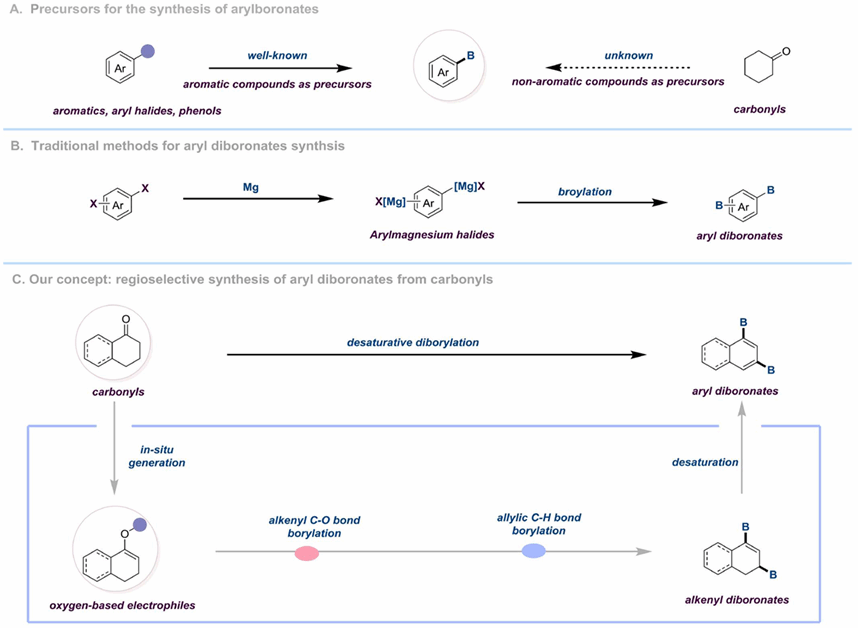
Figure 1. Controlled desaturation boronation of the carbonyl group to afford aryl diboronates.
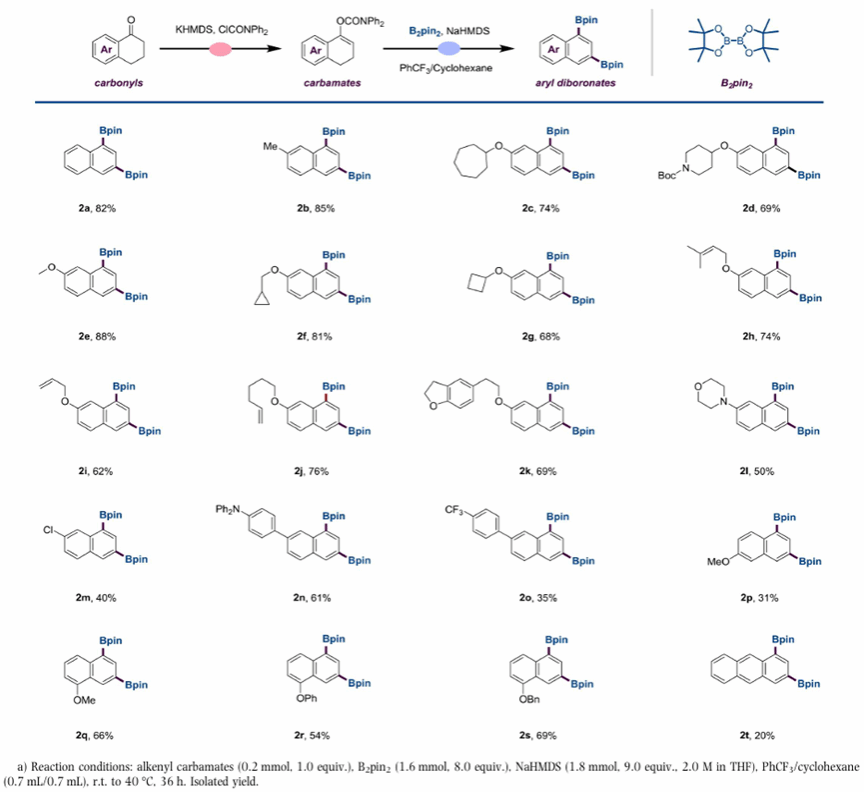
After determining the optimal reaction conditions, the authors evaluated the substrate scope of the NaHMDS-catalyzed desaturation diboronation reaction (Table 2). This reaction exhibits excellent functional group tolerance, accommodating alkenes, allyl groups, amines, OPh, OBn, chlorine, and trifluoromethyl groups. Notably, this system tolerates strained rings in the alkyl chain, such as cyclopropane and cyclobutane, and maintains high efficiency toward both internal and terminal olefinic groups—the latter of which are typically highly sensitive in transition metal-catalyzed boronation reactions.
Table 2. Investigation of substrate scope
The late-stage diboronation transformation of bioactive molecules further demonstrated the synthetic utility of this strategy (Figure 2). Substrates derived from olefine, citronellol, and farnesol exhibited excellent reactivity; their internal olefinic moieties remained intact under the reaction conditions, enabling the efficient preparation of the desired aryl diboronates in good yields. Although efficiency declined upon scale-up to the gram level, the target aryl diboronates could still be obtained in satisfactory yields. Additionally, a one-pot approach was attempted, allowing rapid direct conversion of the carbonyl precursor to aryl diboronates in moderate yields, without the need for intermediate purification.
Aryl diboronates 2a could be efficiently transformed into aryl dichlorides, aryl dibromides, and aryl diiodides. Moreover, these aryl diboronates readily underwent Suzuki coupling reactions under palladium catalysis, efficiently affording 1,3-difunctionalized naphthalene derivatives. Notably, the boron moiety at the 1-position exhibited higher reactivity than that at the 3-position, thereby enabling sequential diversified functionalization of aryl diboronates and providing a viable strategy for the synthesis of 1,3-difunctionalized naphthalene derivatives.
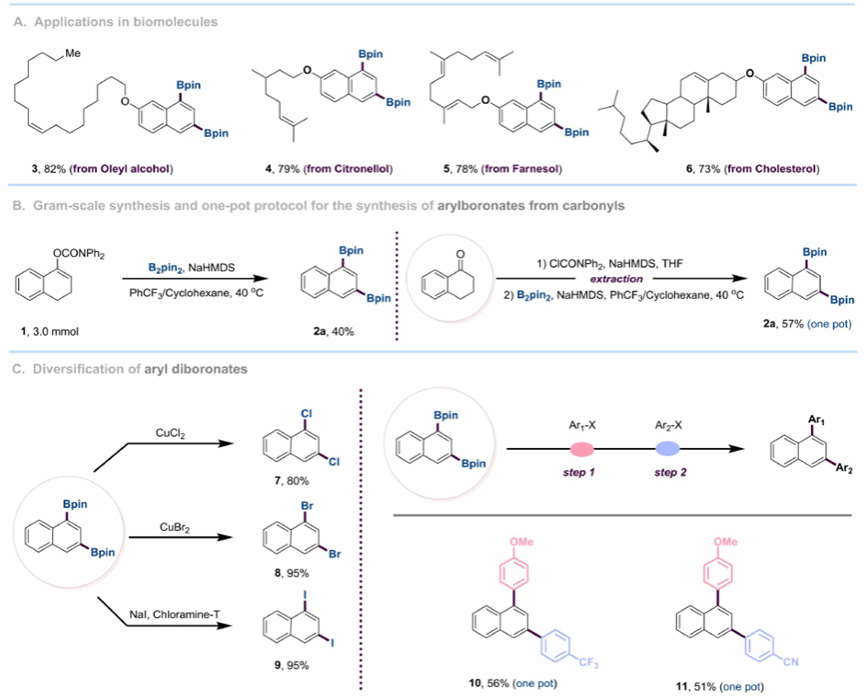
图2. 产物的衍生化及应用
The authors further investigated the mechanism of the diboration reaction (Figure 3). Under standard diboration conditions, aryl mono-boronate 3a′ could not be converted to aryl diboronate 2a. Moreover, in this reaction system, olefin mono-boronate 4a could be isolated. However, 4a did not undergo a second boronation to form aryl diboronate 2a; instead, it yielded aryl mono-boronate 3a′ in moderate yield. These observations indicate that the alkenyl mono-boronate 4a is not an intermediate in the diboration pathway. Encouragingly, the authors successfully detected the highly reactive alkenyl diboronate 4b via HRMS, suggesting its potential as a key intermediate in the diboration reaction. To further elucidate this unprecedented de-saturation process, the authors conducted control experiments. These experiments demonstrated that the reaction proceeded smoothly under degassing conditions, whereas de-saturation did not occur in the absence of the diboronating agent.
These results strongly indicate that the diboronating agent, rather than oxygen, drives the de-saturation step. Based on these findings, the authors proposed a plausible mechanism for this boronation reaction: in the diboration process, the alkenyl carbamate 1 first undergoes allylic C–H bond boronation to afford the mono-boronated product 5b. Subsequently, a second boronation of the olefin C–O bond yields the alkenyl diboronate 4b, followed by deprotonation and de-saturation to afford the desired aryl diboronate 2a. Additionally, to better understand the de-saturation boronation process, the authors also employed DFT calculations to explore the reaction mechanism.
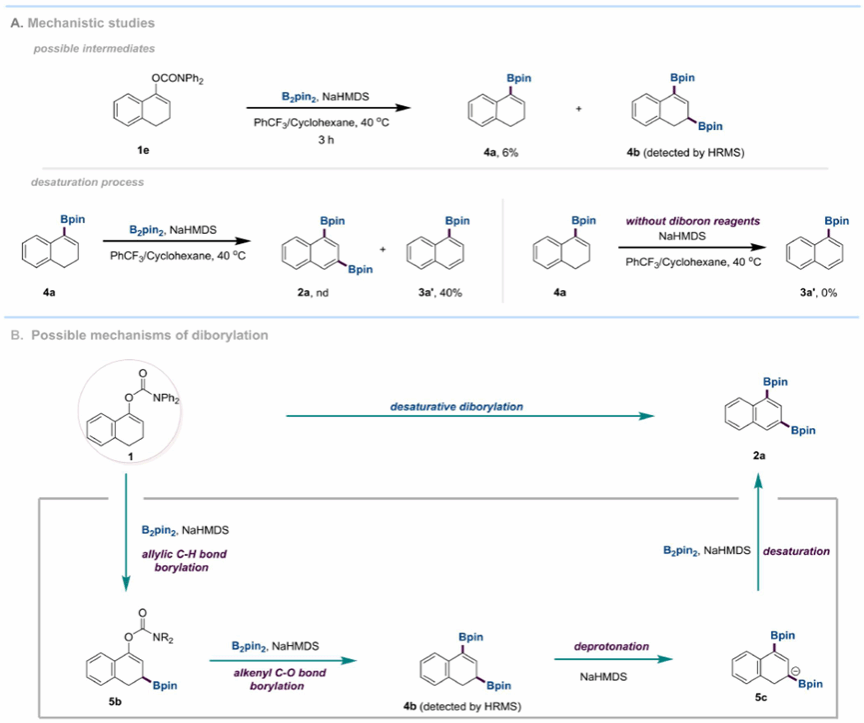
Figure 3. Mechanistic Study
In summary, the authors have developed a transition metal-and additive-free strategy employing NaHMDS to directly synthesize aryl diboronates from carbonyl compounds. This methodology exhibits excellent functional group tolerance, making it well-suited for late-stage functionalization of bioactive carbonyl derivatives. The integration of experimental and computational studies elucidates the pivotal roles of NaHMDS and the diboron reagent in driving the de-saturation process. This work establishes a novel pathway for converting non-aromatic precursors into aryl diboronates and reveals novel reactivity of the base/diboron reagent system, which may inspire new developments in de-saturation transformations.
The related findings were recently published in *Science China Chemistry*; for detailed information, please refer to: Shi C#, Ma C#, An X#, Sun M#, Geng S., He Y., Yang Y*, Ni S*, Feng Z*. Controlled desaturative diborylation of carbonyls. *Sci China Chem*, 2026, DOI: 10.1007/s11426-025-3345-5








 CH
