The increase in atmospheric CO₂concentration has led to climate-related challenges, and electrochemical CO₂ reduction (eCO₂R) represents a crucial pathway toward achieving a carbon circular economy. The economic viability of this technology heavily depends on the development of electrocatalysts exhibiting high activity and high selectivity. Precious metal catalysts suffer from high costs and limited selectivity, whereas molecular catalysts—such as metal porphyrins—face challenges including poor stability and low density of active sites. Covalent organic frameworks (COFs) provide a stable platform for hosting metal porphyrins; cobalt porphyrin-based COFs have emerged as promising candidates for eCO₂R catalysis. However, the impact of their pore structures on catalytic selectivity has not yet been systematically investigated.
Key challenges include the structural instability of conventional cobalt porphyrin-based catalysts under electrocatalytic conditions, low utilization of active sites, and poor mass transfer efficiency.
Systematic studies on the pore structure design of cobalt porphyrin COFs remain limited, and the mechanistic roles of pore size and interlayer spacing in CO₂ adsorption and intermediate stabilization remain unclear.
In small-pore cobalt porphyrin COFs, inert bridged *CO intermediates readily form during the eCO₂R process, hindering CO desorption and thereby reducing catalytic selectivity.
Hydrogen evolution side reactions frequently accompany CO₂ electroreduction; however, existing catalysts struggle to simultaneously enhance CO selectivity and suppress hydrogen evolution.
By extending the linear dialdehyde linker, three cobalt porphyrin-based COFs (Co-TBCOF, Co-TTCOF, and Co-TQCOF) were successfully synthesized, exhibiting pore diameters ranging from 2.5 nm to 3.8 nm and interlayer distances ranging from 3.64 Å to 4.81 Å.
The enlargement of pore size and interlayer spacing enhanced the CO₂ adsorption capacity, increased the positive charge density of the Co sites, facilitated CO₂ activation, and improved charge delocalization capability.
The small-pore COFs (Co-TBCOF and Co-TTCOF) simultaneously stabilize both the active terminal *CO species and the inert interlayer bridged η²-CO intermediates, thereby hindering CO desorption; in contrast, the large-pore Co-TQCOF suppresses η²-CO formation and exclusively generates CO via the τ-CO pathway.
In H-type electrolyzers, Co-TQCOF achieved a CO Faradaic efficiency of 93.3%, while in flow electrolyzers it reached 91.2%. Moreover, Co-TQCOF demonstrated outstanding long-term stability, maintaining selectivity above 80% and 85% after 12 h (H-type electrolyzer) and 24 h (flow electrolyzer) of operation, respectively
Figure and Text Analysis:
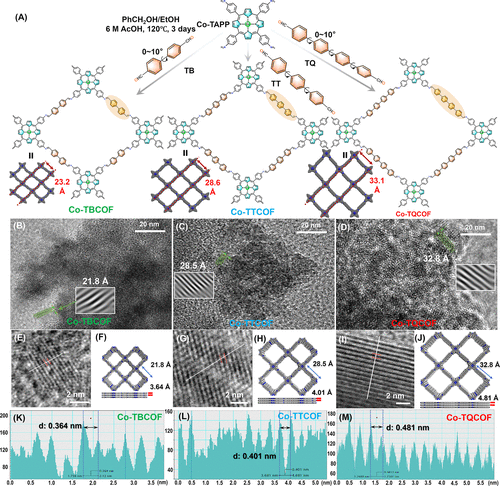
Figure 1:Synthesis routes and microscopic structural characterization of three cobalt porphyrin-based COFs
Synthetic route: Using Co-TAPP as the core node, three linear dialdehydes of varying chain lengths (BPDA, TPDA, QPDA) were sequentially coupled via acid-catalyzed Schiff base condensation reactions to afford Co-TBCOF, Co-TTCOF, and Co-TQCOF, respectively.
High-resolution TEM characterization: All three COFs exhibited well-defined lattice fringes, with d-spacings of the (100) crystal plane being 21.8 Å (Co-TBCOF), 28.5 Å (Co-TTCOF), and 32.8 Å (Co-TQCOF), respectively, demonstrating excellent crystallinity.
Interlayer spacing analysis: FFT maps revealed that the interlayer spacing increased progressively with the length of the coupling ligand (3.64 Å → 4.01 Å → 4.81 Å), attributable to the diminished interlayer interactions caused by C–H steric hindrance between the polycyclic aromatic rings.
Structural models: Top-view and side-view representations clearly illustrate the channel and interlayer stacking architectures of the three COFs, highlighting the systematic increase in both pore diameter and interlayer spacing
Figure 2: Crystal structures, porosity, and CO₂/CO adsorption–desorption performance characterization of three types of COFs
PXRD patterns: The (100) characteristic peaks of the three COFs shift toward lower angles as the pore size increases; the theoretical simulations of the AA stacking model exhibit excellent agreement with the experimental patterns, thereby validating the reliability of the crystal structure models.
N₂ adsorption-desorption isotherms: The BET specific surface area increases progressively with increasing pore size (28.7 → 34.1→40.9 m²/g); BJH pore size distribution indicates that all three COFs are mesoporous materials, with average pore sizes of 1.91,2.72, and 3.04nm, respectively.
CO₂ adsorption performance: At 273 K and 298 K, Co-TQCOF exhibits significantly higher CO₂ adsorption capacity than the other two COFs, attributable to its larger specific surface area and greater number of accessible Co-N₄ sites.
CO₂-TPD and CO-TPD analyses: Co-TQCOF displays the lowest CO₂ desorption temperature (167.3 °C), which facilitates CO₂ mass transfer; in contrast, Co-TBCOF and Co-TTCOF exhibit two CO-TPD peaks (corresponding to τ-CO and η²-CO), whereas Co-TQCOF shows only one τ-CO desorption peak, demonstrating that no inert intermediates are formed in Co-TQCOF
Figure 3: Electrocatalytic CO₂ reduction performance of three COF materials in H-type cells and flow cells
LSV curves: The current density of all three COF-modified electrodes increased with decreasing potential, and all values were higher than those of the bare electrode, demonstrating the catalytic activity of the COFs.
Faradaic efficiency (FE): At the optimal catalyst loading of 1.0 mg/cm², the CO FE of Co-TQCOF reached 93.3% in the H-type cell and 91.2% in the flow cell, both of which exceeded those of Co-TBCOF and Co-TTCOF.
Potential dependence: In the H-type cell, Co-TQCOF exhibited its highest CO FE at-0.7 V (vs. RHE); at more negative potentials, the decline in FE was less pronounced compared to the small-pore COF, owing to its pore structure which mitigates CO₂depletion and proton accumulation issues.
Stability tests: After 12 hours of operation in the H-type cell and 24 hours in the flow cell, Co-TQCOF still maintained high CO selectivity, outperforming the other two COF variants.
Figure 4: In-situ UV-Vis spectroscopy and in-situ ATR-SEIRAS characterization
In-situ UV-Vis spectroscopy: Under an N₂ atmosphere, as the potential decreases, Co(II) is reduced to Co(I), giving rise to characteristic absorption peaks; under a CO₂ atmosphere, the intensity of the characteristic peaks of Co-TQCOF remains essentially unchanged, demonstrating rapid CO₂ reduction kinetics without accumulation of intermediates.
In-situ ATR-SEIRAS: Both Co-TBCOF and Co-TTCOF exhibited characteristic peaks of inert η²-CO (1972–1895 cm⁻¹), whereas Co-TQCOF displayed only characteristic peaks of active τ-CO (2100–2200 cm⁻¹), directly proving that the large pore structure suppresses the formation of inert intermediates
Figure 5: Analysis of charge density, dipole moment, and CO₂ adsorption simulations
Differential charge density analysis reveals significant charge accumulation at the Co site and charge depletion around the porphyrin periphery, demonstrating that the Co-N₄ moiety serves as the catalytic active center.
Dipole moment and Bader charge analysis indicate that an increase in the number of benzene rings within the linker moiety enhances the dipole moment, while the positive charge on the Co-porphyrin ring gradually decreases; consequently, the charge distribution in Co-TQCOF favors electron transfer toward the catalytic site.
GCMC simulations show that in a KHCO₃ electrolyte environment, Co-TQCOF exhibits the highest CO₂ adsorption capacity and the lowest H₂O adsorption capacity, which is consistent with its hydrophobic characteristics and contributes to suppressing the hydrogen evolution side reaction.
Adsorption enthalpy calculations indicate that Co-TQCOF possesses relatively low CO₂ adsorption enthalpy, reflecting moderate adsorption strength that balances adsorption capacity with desorption efficiency
Figure 6: Bader charges, differential charge densities, and DFT free energy calculations
Bader charge analysis: The positive charge at the Co center increases with increasing pore size, thereby enhancing the CO₂ adsorption activation capability.
Differential charge density: Upon CO₂ adsorption, Co-TQCOF exhibits the largest charge transfer, a more pronounced bending of the CO₂ molecule, and superior activation performance.
Free energy profile: The formation of the *COOH intermediate constitutes the rate-determining step of the reaction, and Co-TQCOF possesses the lowest activation barrier for this rate-determining step; τ-CO desorption is thermodynamically more favorable on Co-TQCOF, whereas η²-CO desorption is thermodynamically unfavorable; furthermore, the larger interlayer spacing in Co-TQCOF precludes the stabilization of the η²-CO structure.
Intermediate structures: In τ-CO, the Co–C bond length remains stable; in η²-CO, interactions exist between Co and the O atom; however, the excessively large interlayer spacing in Co-TQCOF renders the Co–O bond interaction negligible, making the formation of η²-CO impossible
Original link:https://doi.org/10.1021/jacs.5c18778








 CH
