Recently, the Haihong Song's team from the School of Chemistry and Chemical Engineering (School of Carbon Neutrality Future Technology) at Shantou University made new progress in the research field of " electrochemical ammonia removal from polluted river water and electrode antifouling." The related research findings were published under the title" Enhancing electrode lifespan in an ammonia removal system: Investigating the potential of polarization reversal and examining long-term scaling mechanisms" in Journal of Water Process Engineering (impact factor 6.6) , a leading international journal in the field of water and environmental engineering.
Paper link:
https://www.sciencedirect.com/science/article/pii/S221471442300939X
Paper title: Enhancing electrode lifespan in an ammonia removal system: Investigating the potential of polarization reversal and examining long-term scaling mechanisms
Authors: Yang Qiu, Haihong Song*, Zhaohua Wang, Songlei Han
Corresponding author: Haihong Song (E-mail: hhsong@stu.edu.cn)
Journal: Journal of Water Process Engineering
Year, volume, article number: 2023, Volume 56, Article 104419
DOI: https://doi.org/10.1016/j.jwpe.2023.104419
Keywords: Ammonia removal; Ion exchange-electrochemical oxidation; Polarization reversal; Electrode scaling; Scaling mechanisms
English abstract of the paper:
This study investigates the potential of polarization reversal for extending the lifespan of electrodes in an auto remote-controlled ammonia removal system and provides insights into the scaling mechanisms that occur after prolonged operation. The results demonstrate that automatic polarization reversal does not influence the average removal rate of ammonia nitrogen but effectively reduces scaling, leading to an extended electrode replacement cycle, improved system stability, and lower operational costs. However, cathode scaling still occurs over time. Fourier transform infrared spectroscopy, X-ray diffraction, and scanning electron microscopy were employed to analyze the scaling mechanism, revealing that the scaling material primarily consists of dolomite crystals, Mg(OH)2, and CaCO3. The formation mechanism is attributed to the disruption of the acid-base balance on the electrode surface during long-term automated polarization reversal, resulting in the detachment of the cathode coating and the nucleation and crystallization of scales in cathode cracks and recesses. Optimization of the polarization reversal program and re-coating of the electrode can enhance electrode passivation during prolonged operation, thereby potentially reducing the need for frequent electrode replacement and lowering associated costs in similar systems. This study provides valuable insights into the long-term operation of ion exchange-electrochemical oxidation systems for ammonia removal.
Graphical abstract:
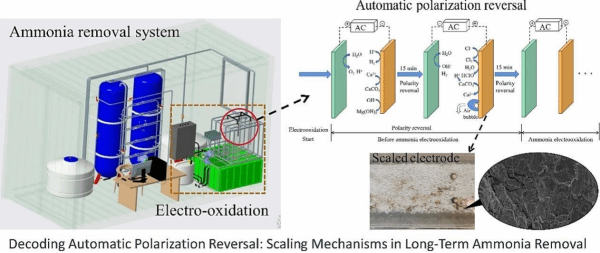
Graphical abstract of Paper 1 (Source: Journal of Water Process Engineering, Vol. 56, Article 104419).








 CH
