Recently, the Ming-Hua Zeng team from the School of Chemistry and Chemical Engineering (School of Carbon Neutrality Future Technology) at Shantou University made new progress in the research field of "Coordination Cluster Assembly and Application". The related research findings were published under the title "Customizing stable Ni(ii)-based cubanes with bidirectional chelation-bridging ligands enables atomic manipulation of fully-exposed metal sites for efficient electrocatalytic UOR" in the top journal "Chemical Science" (impact factor 8.1) in the field of inorganic chemistry.
Authors:
En-Xue Liu, Nan-Feng Liang, Shi-Hao Hu, Tian-Ying Gu, Zheng Yin*, Bin Zhang*, and Ming-Hua Zeng*
Paper information:
Chem. Sci. 2026, 17, 17866-17876.
Paper link:
https://doi.org/10.1039/d6sc04724f
English abstract of the paper:
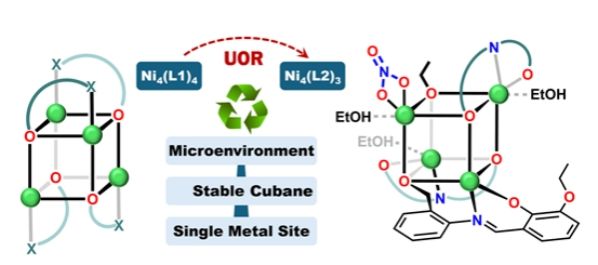
The well-known [M4O4] cubane represents one of the most important catalytic models; however, analogous coordination clusters for effective electrocatalysis were greatly hindered by the limited stability of the conventional [M4L4] motif with dual-site ligands. Aiming to obtain a highly stable cubane for exposure and atomic manipulation of all four active metal sites, a pair of clusters were customized as [Ni4(L1)4(C2H5OH)4] (Ni4(L1)4) and [Ni4(L2)3(C2H5O)(NO3)(C2H5OH)3] (Ni4(L2)3). A series of ligand advantages including bidirectional chelation-bridging coordination, semi-enclosed tridentate O, N, O sites and Schiff-base-linked rigid biphenyl backbone, prevent concurrent dissociation of Ni(ii) and µ3-O node in the cubane. Compared to Ni4(L1)4, a key innovation lies in generation of the Ni4(L2)3 core and incorporation of terminally coordinated nitrate, thereby creating dynamic weakly coordinating metal sites. Through optimized exposure and precisely engineered Ni(ii) active sites, Ni4(L2)3 demonstrates exceptional electrocatalytic activity for the urea oxidation reaction (UOR), requiring a record-low potential of 1.29 and 1.38 V to deliver a current density of 10 and 100 mA cm−2, respectively, outperforming all known coordination clusters, along with stable operation exceeding 120 hours. Mechanistic studies utilizing systematic in situ characterization reveal that the Ni(ii) centers formed via nitrate coordination are essential for stabilizing the key NCO− intermediate and steering the reaction pathway towards N2 generation. DFT calculations further demonstrate that Ni4(L2)3 displays a more pronounced electron delocalization effect upon urea adsorption compared to Ni4(L1)4, resulting in a marked improvement in N2 product selectivity. This work showcases the powerful capacity of molecular customization to achieve tailored stability, regulate active metal sites, and attain exceptional electrocatalytic performance via a new reaction mechanism.








 CH
