Recently, the Ming-Hua Zeng team from the School of Chemistry and Chemical Engineering (School of Carbon Neutrality Future Technology) at Shantou University made new progress in the research field of "Coordination-Directed Domino Reactions". The related research findings were published under the title " Elucidating the Fe(III) Directed 15-Step Domino Inter- and Intramolecular Progressive Coordinative Oligomerization of a Heterocycle Aggregate" in the top journal "Aggregate" (impact factor 14.5) in the field of organic chemistry.
Authors:
Kai-Bin Chen, Ting-Ting Wang, Zhi-Wei Xu, Ning Tian, Jin Cai, Wen-Yu Qiu, Bin Zhang, Zheng Yin, Bin Liu, Ming-Hua Zeng*
Paper information:
Aggregate 2025, 6, e70094.
Paper link:
https://doi.org/10.1002/agt2.70094
English abstract of the paper:
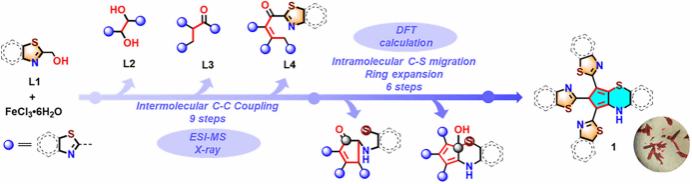
Benzo[d]thiazol-2-ylmethanol undergoes progressive oligomerization under solvothermal conditions in the presence of FeCl₃·6H₂O, yielding a heterocyclic aggregate, namely 1,2,3-tris(benzo[d]thiazol-2-yl)-2,9-dihydrobenzo[b]cyclopenta[e][1,4]thiazine. Single-crystal X-ray diffraction analysis was conducted on four distinct compounds isolated during the reaction, and electrospray ionization mass spectrometry (ESI-MS) of both solid products and intermediate reaction solutions enabled the identification of 15 consecutive reaction steps, where Fe(III) was directly involved in eight steps. These transformations comprise nine intermolecular C─C coupling events and six intramolecular ring expansion processes. The heteroatoms (N, O, and S) play distinct mechanistic roles according to their positions within the heterocyclic framework: (1) nitrogen and oxygen coordinate with Fe(III), facilitating activation of the reaction site; (2) homolytic cleavage of the C─O bond promotes C─C coupling reactions; and (3) C─S migration induces intramolecular ring expansion. Notably, theoretical calculations indicate a decrease in Gibbs free energy along the intramolecular reaction pathways, substantiating the proposed mechanism and activation mode, which underscores the essential role of Fe(III) in enabling the reaction progression. Furthermore, an investigation of the photophysical properties revealed that the resulting heterocyclic aggregates exhibit strong luminescence within the 535–610 nm wavelength range, approaching the near-infrared region. These findings highlight the significance of this reaction pathway in the controlled synthesis of functional oligomers and polymers from monomeric precursors, particularly through catalysis by cost-effective metal ions.








 CH
