Research areas: metal bioaccumulation and toxicokinetics; water quality criteria; combined effects of emerging contaminants.
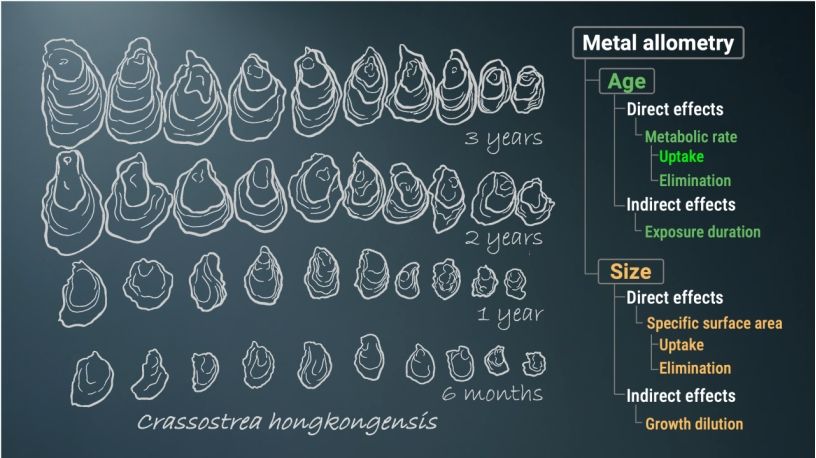
Research Update 01 | New Progress in “Age, Size, and Growth Effects on Metal Accumulation in Oysters”
Allometry describes the disproportional scaling of physiological processes with body size. This challenges the assumption of a direct relationship between metal concentrations in organisms and environmental levels, a premise commonly used in biomonitoring programs. However, deciphering the complex drivers of metal allometry is difficult because size and age often confound each other. In this study, we took advantage of a natural experiment provided by populations of oysters of known ages that exhibited substantial size variation within the same age cohorts. Using a stable metal isotope tracer technique, we examined the bioaccumulation of six metals (60Ni, 65Cu, 68Zn, 107Ag, 114Cd, 206Pb) under both dissolved and dietary exposures. Our results indicate that bioaccumulation efficiency primarily drives the allometric patterns of metal concentration, with age exerting a more pronounced influence than size. Older oysters showed a diminished bioaccumulation capacity, leading to negative correlations between metal concentrations and size. Meanwhile, indirect factors such as growth dilution played a minor role, and exposure duration had a negligible effect. This study enhances our understanding of the complex mechanisms governing metal bioaccumulation in marine organisms and provides critical insights for improving the interpretation of biomonitoring data.
Cao X, Wang T, Qian J, Xiong H, Chen CC, Xie M, Chen R, Tan Q-G*. Natural experiment reveals lower metal levels in older oysters: Disentangling age, size, and growth effects. Environmental Science & Technology. 2025;59(23):11468–11476.
DOI: https://doi.org/10.1021/acs.est.4c14489
Keywords: allometry; stable isotope tracing; bioaccumulation; age effects; biomonitoring.
Research Update 02 | Particle-Bound Copper and Water Quality Criteria
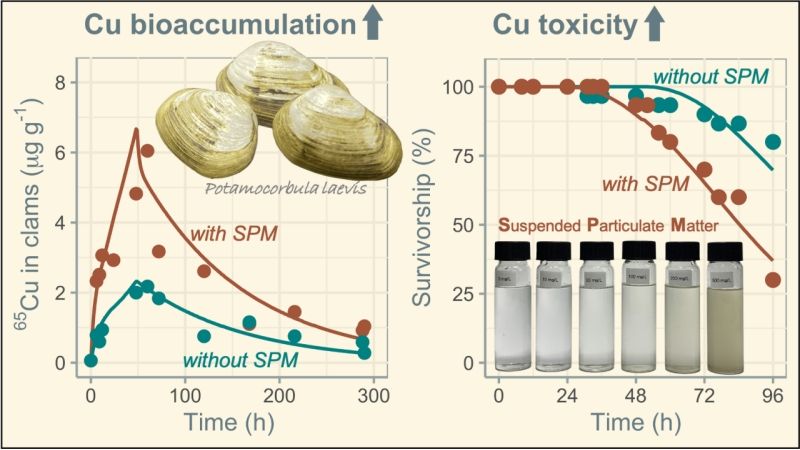
In coastal waters, particulate metals constitute a substantial fraction of the total metals; however, the prevalent water quality criteria are primarily based on dissolved metals, seemingly neglecting the contribution of particulate metals. Here we developed a method to quantify the toxicity risk of particulate metals, and proposed a way to calculate modifying factors for setting site-specific criteria in turbid waters. Specifically, we used a side-by-side experimental design to study copper (Cu) bioaccumulation and toxicity in an estuarine clam, Potamocorbula laevis, under the exposure to "dissolved only" and "dissolved + particulate" 65Cu. A toxicokinetic-toxicodynamic model (TK-TD) was used to quantify the processes of Cu uptake, ingestion, assimilation, egestion, and elimination, and to relate mortality risk to tissue Cu. We find that particulate Cu contributes 40–67% of the Cu bioaccumulation when the suspended particulate matter (SPM) ranges from 12 to 229 mg L−1. The Cu-bearing SPM also increases the sensitivity of organisms to internalized Cu by decreasing the internal threshold concentration (CIT) from 141 to 76.8 μg g−1. Modifying factors were derived based on the TK-TD model to consider the contribution of particulate Cu (in the studied SPM range) for increasing Cu bioaccumulation (1.3–2.2) and toxicity (2.3–3.9). Overall, the method we developed provides a scientifically sound framework to manage the risks of metals in turbid waters.
Cao X, Yu Z-X, Xie M, Pan K, Tan Q-G*. Higher risks of copper toxicity in turbid waters: Quantifying the bioavailability of particle-bound metals to set site-specific water quality criteria. Environmental Science & Technology. 2023;57(2):1060–1070. DOI: https://doi.org/10.1021/acs.est.2c06447
Keywords: copper; suspended particulate matter; toxicokinetic–toxicodynamic model; metal bioavailability; water quality criteria.
English abstract of the paper:
Other Selected Peer-Reviewed Publications (2023–2026)
* Corresponding author. # Equal contribution.
Liu F#, Cao X#, Hao Y, Li Z, Zhang C, Chen X, Zhou L*. Suspended particulate matter acts as a co-stressor to amplify imidacloprid impacts in estuarine mussels. Journal of Hazardous Materials. 2026;515:143245. DOI: https://doi.org/10.1016/j.jhazmat.2026.143245
Cao X*, Tan Q-G. Model-based refinement of metal water quality criteria: Advances in biotic ligand model, multiple linear regression, and toxicokinetic-toxicodynamic approaches. Aquatic Toxicology. 2025;288:107559. DOI: https://doi.org/10.1016/j.aquatox.2025.107559
Cao X, Zhong G, Pan K, Qian J, Xie M, Chen R, Liao Y, Tan Q-G*. Interspecific calibration of metal concentrations in mussel watch using toxicokinetics. Science of the Total Environment. 2023;883:163703. DOI: https://doi.org/10.1016/j.scitotenv.2023.163703
Cao X, Li Z, Fan X, Deng H, Dong Y, Song Z, Gao M*. Polystyrene nanoplastics exert dual roles in modulating sertraline hydrochloride toxicity in hydroponically grown rice. Environmental Science: Nano. 2026;13(9):3721–3733. DOI: https://doi.org/10.1039/D5EN00913H
Liu F, Cao X*, Zhou L*. Lipid metabolism analysis providing insights into nonylphenol multi-toxicity mechanism. iScience. 2023;26:108417. DOI: https://doi.org/10.1016/j.isci.2023.108417
Liu F, Cao X*, Tian F, Lin K, Cheng J, Hu X*. Continuous and discontinuous multi-generational disturbances of tetrabromobisphenol A on longevity in Caenorhabditis elegans. Ecotoxicology and Environmental Safety. 2023;251:114522. DOI: https://doi.org/10.1016/j.ecoenv.2023.114522







 CH
