Recently, the Ming-Hua Zeng team from the School of Chemistry and Chemical Engineering (School of Carbon Neutrality Future Technology) at Shantou University made new progress in the research field of "MOF Glasses Fabrication and Phase Evolution". The related research findings were published under the title "The phase and energy-level evolutions in seven distinct sequential states and their hierarchical memory effect of isomeric MOFs" in the top journal "Science Bulletin" (impact factor 20.7) in the field of inorganic chemistry.
Authors:
Rui-Fang Ma, Jia-Xin Wu, Ming-Zhu Chen, Tao Liu, Jian Li, Yi-Bo Zhang, Lei Shi, Sheng Liao, Fei Gao, Yi-Hang Guo, Yingbo Zhao, Zheng Yin*, and Ming-Hua Zeng*
Paper information:
Sci. Bull. 2026, 71, 4429–4438.
Paper link:
https://doi.org/10.1016/j.scib.2026.07.057
English abstract of the paper:
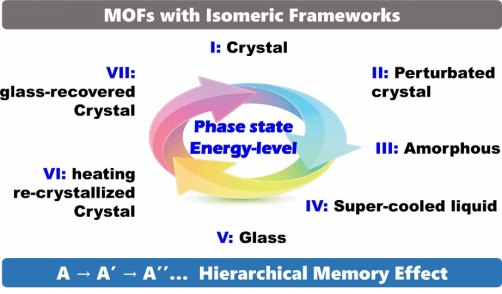
The emerging multi-phase evolution of metal-organic frameworks (MOFs) is advancing condensed matter physics and dynamic chemistry toward the next holy grail beyond current remarkable successes. To clarify the complex interplay between static and dynamic structure/energy factors governing molecular connection reservation, dissociation, and aggregation, the first serialized MOFs multi-phase evolutions were identified containing seven relevant phase states. The starting three MOFs with isomeric frameworks, that are [Co2L4]·2DMF, [CoL2]·DMF, and [CoL2]·2DMA (labeled as c1–c3, state Ⅰ), transform to similar hydrated products h1–h3 (stateⅡ), which are comparable to hydrogen-bonded framework [CoL2(H2O)4] (c4). Thermal dehydration of h1–h3 and c4 led to disorder and porous frameworks p1–p4 (state Ⅲ), which underwent glass transition to super-cooled liquid scl1–scl4 (state Ⅳ, ∆Tscl = 10–24 K). MOFs glasses g1–g4 (state Ⅴ, Tg = 509–513 K) and re-crystallized MOFs rec1–rec4 (state Ⅵ, Tc = 535–547 K, analogues of de-solvated c2) were generated from quenching and overheating scl1–scl4. Glass-recovered crystals r1–r4 (state Ⅶ, comparable to c2 or c3) were harvested by soaking g1–g4 in DMF or DMA solvents. For the first time, the enthalpy change between different phase states and their precise energy levels were established. The MOF glasses possess CO2 accessible porosity with a broad pore size range of 4–15 Å, and can be fabricated to be a crack-free membrane. These results demonstrate a concept of hierarchical memory effect, characterized by self-adaptive yet limited distortion of metal nodes driven by coordinative bond reversibility, restricted ligand movement in condensed state, and divergencer/convergence during framework disassembly/reassembly. This effect elucidates the origins of phase state evolution, offering new insights into MOF dynamic chemistry and advancing it to unexplored frontiers.







 CH
