Recently, the Ming-Hua Zeng team from the School of Chemistry and Chemical Engineering (School of Carbon Neutrality Future Technology) at Shantou University made new progress in the research field of " Multi-stage transformations of a cluster-based metal-organic framework: perturbing crystals to glass-forming liquids that re-crystallize at high temperature" in the top journal "Angewandte Chemie International Edition" (impact factor 17.6) in the field of inorganic chemistry.
Authors:
Ming-Zhu Chen, Jian Li, Sheng Liao, Yi-Hang Guo, Tao Liu, Rui-Fang Ma, Tian-Yi Xie, Wei-Dong Liu, Si-Xu Peng, Xiaojun Kuang, Zheng Yin*, Yingbo Zhao*, Ming-Hua Zeng*
Paper information:
Angew. Chem. Int. Ed. 2023, 62, e202305942.
Paper link:
https://doi.org/10.1002/anie.202305942
English abstract of the paper:
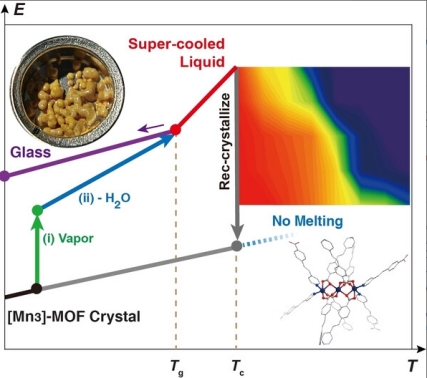
Glassy and liquid state metal–organic frameworks (MOFs) are emerging type of materials subjected to intense research for their rich physical and chemical properties. In this report, we obtained the first glassy MOF that involves metal-carboxylate cluster building units via multi-stage structural transformations. This MOF is composed of linear [Mn3(COO)6] node and flexible pyridyl-ethenylbenzoic linker. The crystalline MOF was first perturbed by vapor hydration and thermal dehydration to give an amorphous state, which can go through a glass transition at 505 K into a super-cooled liquid. The super-cooled liquid state is stable through a wide temperature range of 40 K and has the largest fragility index of 105, giving a broad processing window. Remarkably, the super-cooled liquid can not only be quenched into glass, but also recrystallize into the initial MOF when heated to a higher temperature above 558 K. The mechanism of the multi-stage structural transformations was studied by systematic characterizations of in situ X-ray diffraction, calorimetry, rheological, spectroscopic and pair-distribution function analysis. These multi-stage transformations not only represent a rare example of high temperature coordinative recognition and self-assembly, but also provide new MOF processing strategy through crystal-amorphous-liquid-crystal transformations.







 CH
